Karmaia Adventures & Avasar Nepal: Journeys Creating Opportunities for Young Women

With every journey you take with Karmaia Adventures, you become part of something much bigger. A portion of Karmaia’s profits supports the education, empowerment, and development of young girls in Nepal.

At Karmaia Adventures, we believe that every journey should leave something good behind. Our mission isn’t just about crossing high mountain ridges or trekking through pristine valleys; it’s also about making a positive impact on the lives of people who live in the communities along the paths we travel. This belief inspired our partnership with Avasar Nepal, an initiative founded by our own founder Mingma Sherpa to create educational opportunities for young girls in Nepal’s most remote regions.

Across rural Nepal, young women continue to face profound barriers to education. Many walk long, often unsafe journeys to school, while family poverty can force them into work instead of the classroom. Deeply rooted gender norms often prioritise sons’ education, and many girls are expected to marry young. In some communities, schools lack proper infrastructure, qualified teachers, or even basic facilities. These challenges combine to deny countless capable young women the chance to learn, grow, and contribute to their communities.

Both Karmaia Adventures and Avasar Nepal share a single purpose: to build pathways of opportunity where they are needed most. While Karmaia brings travellers from around the world to experience Nepal’s breathtaking landscapes, Avasar Nepal focuses on empowering young girls whose dreams are often limited by circumstance rather than potential.

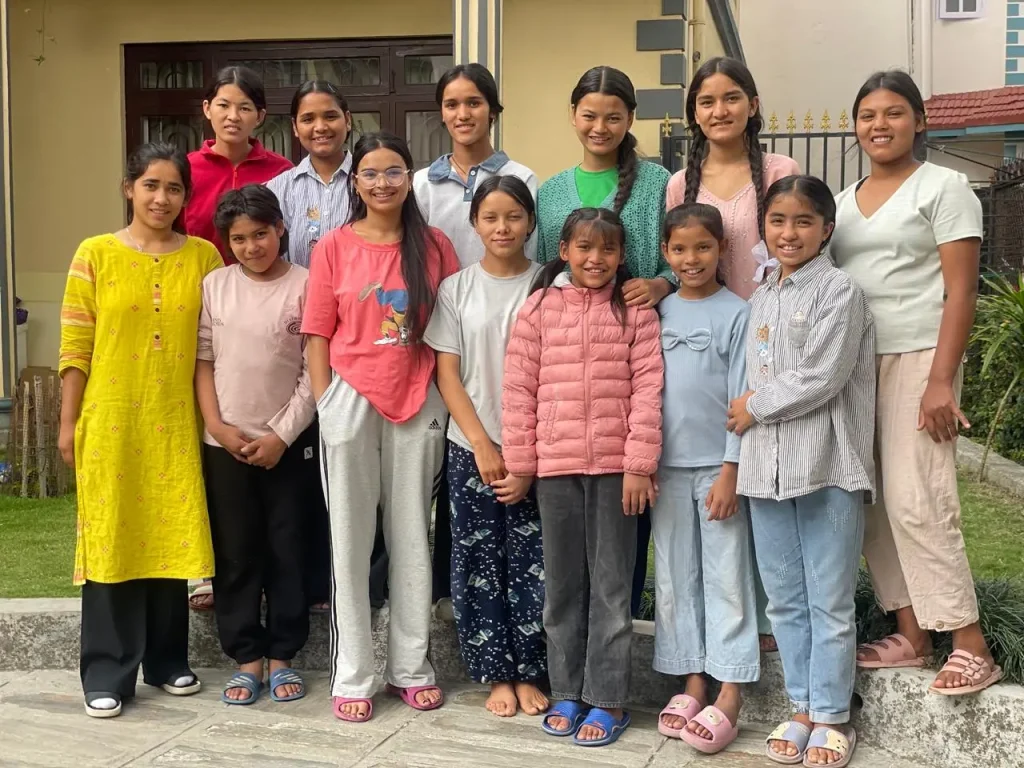
A portion of Karmaia’s profits goes directly to Avasar Nepal. At present, Avasar supports thirteen girls in their education and personal development, and over the years, more than twenty girls have been able to pursue their studies and grow into confident, independent young women.

The support provided through Avasar Nepal goes beyond paying school fees. It ensures that girls have access to boarding, uniforms, and learning materials, as well as mentorship and guidance that help them stay motivated and complete their education. Alongside academic support, Avasar offers life-skills and leadership training, helping girls build confidence, financial literacy, and a strong sense of self.

When you travel with Karmaia, you become part of a greater story — one that links the joy of exploration with the power of education and opportunity. Every summit reached and every trail completed makes a positive impact on the lives of the girls supported by Avasar Nepal, who in turn aspire to return to and strengthen their communities.

For Karmaia Adventures, giving back is not a separate act of charity; it’s woven into the fabric of who we are. The word “Avasar” means “opportunity” in Nepali, a fitting name for an initiative that unlocks doors for the daughters of Nepal.

You can learn more about Avasar Nepal’s work at avasarnepal.com.np and see how each journey you take with Karmaia Adventures contributes to this shared vision. Together, we can make travelling a force for good — uplifting lives, expanding horizons, and keeping the spirit of the Himalayas alive in every act of kindness.

Sipping Butter Tea with the Family in Langtang Valley

In December 2023, during our Christmas holidays, the family came together when my parents revisited their long-held but unfulfilled dream of trekking in the Himalayas. To our surprise, Nepal had been on their travel list for years. Both in their early fifties, had trekked in the Alps during their youth but had never set foot in the Himalayas.

And so, the planning began. We started by researching online – when to travel, what to expect, and which routes might suit us. While my sibling and I quickly decided to join, our two younger cousins also expressed interest. Soon enough, we were a group of six, poring over information about Nepal: its mountains, culture, and trekking seasons. The resources available were abundant, detailed itineraries, guides to different regions, videos, and travelogues, all useful in their own way. Yet, given our preferences and group dynamic, we wanted something more personal.

A Nepali friend recommended Karmaia Adventures, and through them we were connected with Mingma, who carefully designed a custom itinerary for Langtang Valley. He struck the right balance between adventure and comfort, allowing us to move at our own pace. From arranging trekking permits to securing transport and lodging, Karmaia took the logistical weight off our shoulders.

We began in Kathmandu, where the streets buzzed with life. After a day of exploring the capital, we set off in a private jeep towards Syabrubesi, the trek’s starting point. The winding mountain roads revealed terraced hillsides and deep valleys, foreshadowing the landscapes that awaited us.

The first day on the trail was gentle, leading us through rhododendron forests, suspension bridges, and the steady sound of the Langtang Khola rushing by our side. For our parents, the slower pace was welcome. They paused often to take photos or rest at the small teahouses dotted along the route. We were joined by Nirmal, a young guide, who encouraged frequent breaks, reminding us that trekking in Nepal is as much about enjoying the journey as it is about reaching the destination.

As we climbed higher, the terrain shifted. Forests gave way to alpine meadows, and the air grew crisper. Every bend revealed something new – snow peaks glistening in the distance, yaks grazing on the slopes, mani walls carved with Buddhist prayers guiding our path. Evenings were equally special: gathered in teahouse dining rooms, sipping traditional hot butter tea around the stove, and sharing the day’s stories. It became a time for bonding, for laughter, and for learning. Nirmal taught us phrases in Nepali, explained the symbolism of prayer flags, and pointed out local herbs used in traditional medicine, and by the end of the trek, he too was like family.

Arriving at Langtang Village, rebuilt after the devastation of the 2015 earthquake was deeply moving. Listening to stories of the tragedy, we were humbled by the resilience of the local community. The trek became more than just a journey through mountains; it was also a connection with a culture and history that ran deeper than the scenery.

The final stretch to Kyanjin Gompa felt like stepping into another world. At over 3,800 metres, the valley opened wide, framed by towering peaks such as Langtang Lirung. Our younger cousins scrambled up to Kyanjin Ri for a sunrise hike, while our parents chose a quieter morning at the monastery, sipping fresh butter tea and soaking in the stillness. Everyone found their own rhythm, yet we always came together in the evenings to marvel at what we had experienced.

Trekking in Nepal can seem daunting – permits, transport, language barriers – but Karmaia Adventures ensured everything ran smoothly. From passes and teahouse stays to providing a guide who brought the trail to life, Mingma wove practicality with heart.

On the last day, retracing our steps down the valley, we reflected on what had brought us there. It wasn’t just the allure of the Himalayas; it was the chance to share something unforgettable across generations. Our parents rediscovered their trekking spirit, while we children and cousins bonded in ways only possible in the mountains. Together, we carried home a piece of Nepal that would perhaps be shared over Christmas through generations.

A Trek to Sama Gaon in the Manaslu Region

It was spring in Europe, and Patrick, Javier, and I were excited. Three years ago, we had had to postpone our trip to Nepal due to Covid restrictions. Finally, we were able to head down and complete our wish to complete a trek in Nepal.

We touched down in Kathmandu on a clear day, and at the airport, Lakpa, our travel companion in Nepal, was waiting to greet us. Lakpa was from Karmaia Adventures, co-founded by Mingma and Mirel. We had been connected with them through mutual friends in Spain who recommended Karmaia Adventures. We loved their approach, and over two video calls, they had crafted a wonderful itinerary for us, including assistance with hotel bookings and paperwork for the trek. It was they who had suggested we trek to Sama Gaon, as we wanted an authentic, not-too-crowded experience, but also had only one week to complete the entire trek.

Lakpa was cheerful and attentive. After asking us how our journey had been, he took us to the hotel. Kathmandu was colourful and bustling, with a temple or ancient structure seemingly every kilometre. In the evening, Lakpa took us to Kathmandu Durbar Square and then to Thamel for light drinks and dinner. When we asked if we needed to do anything for the permits, we were surprised to find everything had already been arranged. Lakpa handed us two permits — one, the Manaslu Restricted Area Permit (RAP), and two, the Manaslu Conservation Area Project (MCAP).

The next day, our journey began with a long and bumpy drive to Machha Khola. From the windows of our jeep, we caught glimpses of terraced hillsides, scattered villages, and the river carving its way through deep gorges. By the time we reached Machha Khola, it was already evening. Lakpa asked us to settle in and said, “Tomorrow, the real walk begins.”

The following morning, we set out with our back packs and heavy excitement. Walking along the Budi Gandaki, we realised how different this trek was – the trail was narrower, often hugging cliffsides or dropping steeply to the roaring river below. Sometimes it was a suspension bridge that carried us across, swaying gently as we stepped, with glacial waters raging beneath.

By the time we reached Jagat, we were already feeling the remoteness. The village was small, its stone houses clustered along the trail. There were fewer trekkers than I’d expected. Our guide organised our permits and accommodation with ease, and I silently thanked him for navigating the logistics that felt very complicated in this region.

The walk from Jagat to Deng tested us further. The trail seemed to rise and fall endlessly, at times narrowing into rocky ledges where we pressed close to the cliff, careful not to look down at the torrent below. At other points, it widened into lush sections where waterfalls tumbled down, feeding into the Budi Gandaki. We stopped often, not just to catch our breath, but to take in the sheer rawness of the landscape. The river seemed like a constant companion — sometimes thundering, sometimes whispering, but always reminding us of how deep into the gorge we had gone.

Crossing Philim, we began to feel the shift in altitude. Villages were more scattered, fields less abundant, and life seemed harder here. Lakpa, who seemed to know everyone along the way, greeted locals and exchanged quick conversations. He had a deep knowledge of the region, and as we entered Tsum Nubri Valley, he explained that the entire Tsum Valley prohibited the killing of animals for sacred reasons. He told us about a temple, the Sarong Gumba, high up in the mountains, where animals are said to eat directly from the hands of monks. Along the way, he pointed out details we would have missed on our own – the prayer flags fluttering at village entrances or the long ancient mani walls etched with Buddhist mantras. His knowledge gave perspective to the long hours of walking.

By the time we reached Namrung, the mountains began to rise closer, snow peaks peeking from behind the ridges. The air grew crisper, the villages quieter, and our excitement surged — Sama Gaon was near. That final stretch from Namrung to Sama Gaon felt long but exhilarating. The trail opened gradually, the gorge giving way to broader valleys, and the Budi Gandaki, which had been a roaring companion at our side for days, finally mellowed into a calmer stream.

Reaching Sama Gaon felt like arriving at the heart of Manaslu. The village sat tucked against the backdrop of towering peaks, with Manaslu herself looming above, shrouded in clouds. Yaks grazed lazily in the fields, children played in the courtyards, and the prayer flags fluttered endlessly in the mountain wind. We sat on a stone wall, watching the evening light drape the village, and it felt as though time had slowed to match the rhythm of this remote place.

Yet, with that arrival came a sense of regret. The Manaslu Circuit, one of the great Himalayan trails, was just beyond us — the Larkya La Pass waiting for those who had the time and preparation to cross it. For us, Sama Gaon was the final stop. A part of us ached to push further, to complete the circuit, but another part knew this short trek had given us a capsule of the Manaslu experience: the relentless rise and fall of trails, the intimacy of walking alongside the Budi Gandaki for days, the remoteness that made every village feel like a discovery, and the sudden, overwhelming presence of the high peaks.

The return journey retraced our steps, and yet it felt different. Downhill, the trails seemed gentler, though no less narrow. The Budi Gandaki once again became our companion, guiding us back, its roar fading gradually as we descended into lower valleys.

Looking back, the trek to Sama Gaon may not have taken us over the high pass, but it gave us something just as valuable. It revealed a raw, remote part of Nepal where the mountains still feel untamed, where the trails demand focus, and where the river reminds you of your smallness at every turn. Perhaps one day, I will return to complete the circuit — but for now, Sama Gaon holds a chapter of its own in my story of the mountains.

A Trek to Poon Hill with the Family

Moving away from home in my early twenties, Nepal always pulled me back. As someone who had trekked across the Langtang and Annapurna regions in my late teenage years, there were many days when the hauntingly beautiful images of the trek flashed through my mind. Sometimes, I would be on the train headed to work, and other days I would be shopping for groceries. Every time the flashes occurred, my heart would ache – and I would find myself longing to head back to the mountains. But a chance never arrived, and very slowly life happened – a husband, a kid, bills, a mortgage.

However, last year we decided to head back home during the Dashain holidays, and it so happened that we had a week to ourselves. We then began contemplating the idea of a trek. Being with a six-year-old meant we could not just pack our bags and leave. Still, I wanted my son to take with him a piece of Nepal, and my husband and I began exploring our options.

I had been to the Annapurna Region before but hadn’t had a chance to visit Poon Hill. After some research, we learned that if we paced ourselves, we could do the trek – and we would also get a few days in Pokhara. As we shared our plans with the family, our twelve-year-old niece also decided to join us.

So, one beautiful morning, we flew into Pokhara. Once in Pokhara, we settled in for the day by the lake, enjoying an idyllic afternoon. The next morning, we hired a jeep and headed towards Ulleri. Although people usually begin their trek from Nayapul, our driver informed us that we could drive a little higher up to Ulleri.

We reached Ulleri around 11, and after enjoying a warm lunch, we slowly began our trek. The children were excited, and we made our way out of Ulleri through the mud and stone trail. The trail was wide enough to prevent any worries about narrow passages and wasn’t too high or precarious. We were still cautious with the six-year-old and gently made our way through the dense forest, the river by our side. I silently wished it was the rhododendron season, for I knew this trail would bloom during spring, but autumn had its own charm. The kids were having fun so far, the six-year-old fascinated with every sight – especially when the long train of mules ferrying goods would appear. He asked if we could swim in the stream, but we had to say no. The elder one was fascinated too but had fewer questions. Both, however, continuously asked, “Have we arrived yet?” or “How far is it?” Finally, we reached Ghorepani. The trek was supposed to take four hours, but it took us six.

We settled into a comfortable inn, and the innkeepers were kind enough to give us a family room that would accommodate the four of us. Enjoying a warm meal by the hearth in the dining area, we settled in for the night.

The next morning, we woke up at five – well, at least the parents. The kids weren’t pleased to wake up so early but nonetheless got ready, and we began the walk. It was going to be a steep uphill climb, and we were prepared for some resistance. There was a line of trekkers making their way to catch the magical sunrise from Poon Hill, and we joined them. The walk was slow, and my husband had to carry our son during certain stretches. At other times, we cheered him on. Our niece was exhausted too and didn’t understand what hundreds of people were doing so early in the morning, climbing a hill.

It was already dawn when we arrived at the top, and the sun had just begun to rise, casting an orange hue over the snow-capped peaks of Dhaulagiri and Annapurna. We were just on time. The kids, who not long ago had been complaining, were spellbound, captivated by the panoramic beauty. The adults too were, along with hundreds of others, exclaiming, “This view is so worth it.”

A long time ago, someone had told me that poets make their way to Poon Hill to watch a sunrise just for inspiration, and staring at the view ahead of us, I understood what he meant. While words fail me now, the experience was surreal. We sat in silence for a while, taking in the majestic grandeur.

Surprisingly, there was a tea stall high up on Poon Hill, and my husband and I got ourselves a cup each. Rummaging through our small backpack, we found some biscuits and shared the meal. I looked at my husband, and I knew he too had fallen in love with trekking. It was his first time trekking, and now I knew he would understand what I meant when I told him about the beauty of a trek.

The children had found some sticks and were playing with each other as we beckoned them to head downhill. Slowly, we made our way through the stairs, stopping at times to take in the view of the valley ahead of us. Back at Ghorepani, we ordered our breakfast, packed up our backpacks, enjoyed a hearty meal, and pushed further.

Within 15 minutes, there was another set of steep stairs, and both children looked at us with a “Not again!” expression. The six-year-old ran to his father asking to be carried. Carrying him for a while, and with plenty of breaks and gentle encouragement, we continued forward to arrive at a plateau-like surface. Here, we sat for a while, taking in the view. From there until Tadapani, we crossed through dense forests covered with oaks. Occasionally, the forests opened to offer panoramic views. We had to be careful as the path here was mossy and slippery in places; otherwise, it was mostly gentle and downhill.

We arrived in Tadapani in the late afternoon and settled into our rooms. After an early dinner, both children, exhausted, were asleep by eight. The next morning, we took it easy, and both the children and my husband complained that their legs hurt. We debated staying an additional day to rest but decided to continue to Ghandruk.

Slowly, we moved forward, and in the denseness of the jungle, I found my thoughts wandering all over the place. It was so tranquil and reflective, it was almost meditative.

Around lunchtime, we arrived at Ghandruk – the picturesque village that everyone dreams of. Set against the backdrop of Mt. Machhapuchhre, Ghandruk is an internationally recognised village with stone-paved lanes, slate-roofed houses, and terraced hillsides. Here, all of us threw down our backpacks and sat in the garden, ordering lunch.

The rest of the afternoon, we didn’t get much done – just sat back and enjoyed our last night in the Annapurna region. The children were busy, the twelve-year-old niece taking pictures of the views that surrounded her, the six-year-old running around the garden, asking questions as random as how to climb the mountain that lay ahead of him, to what the firewood oven at the hotel was. I wondered if he had forgotten his legs hurt.

The next morning, we slowly made our way towards the bus stop where our jeep had arrived. With the Modi Khola by our side, we left the Annapurna Region and made our way back to Pokhara.

It’s been two years since we did the trek, and when I was asked by Mingma if I would write a travelogue about the experience, despite the hecticness of life, I found myself saying yes. Just another excuse to take me back to the mountains.

Reflecting on the trek, it was almost transformational. It reminded us that children are far more capable than we sometimes give them credit for. When people ask if trekking with kids in Nepal is possible, I now say: absolutely. It’s not always easy – there are tired legs and the need to adjust your expectations. But it’s also unforgettable. For us, the Ghandruk–Poon Hill trek wasn’t about conquering mountains. It was about discovering them together, through the eyes of a child, through the laughter of cousins, through the quiet pride of arriving somewhere as a family.

Things to pack: A guide

Clothing

  1. Base Layers (Moisture-Wicking) 
  • Thermal tops and bottoms (synthetic or merino wool) 
  • Lightweight, quick-dry trekking t-shirts (2–3) 
  • Long-sleeve shirts (for sun protection) 

2. Insulation Layers 

  • Fleece jacket or pullover 
  • Down jacket (essential for cold nights and high altitudes) 
  • Lightweight, packable insulated vest (optional) 

3. Outer Layers

  • Waterproof and windproof jacket (Gore-Tex or similar) 
  • Waterproof and windproof pants (for rain or snow

4. Trekking Pants

  • Thermal tops and bottoms (synthetic or merino wool) 
  • Lightweight, quick-dry trekking t-shirts (2–3) 
  • Long-sleeve shirts (for sun protection) 

Footwear

  • Sturdy, broken-in hiking boots (waterproof and ankle-supporting) 
  • Lightweight trekking shoes or sandals (for evenings or rest days) 
  • Gaiters (optional – useful in snow or muddy conditions) 

Gears

1. Backpacks 

  • Main backpack (40–50L, depending on porter use) 
  • Daypack (20–30L, if you’re using a porter) 
  • Waterproof backpack cover or internal liner 

2. Sleeping Gear  

  • Sleeping bag (comfort rated to at least –10°C / 14°F) 
  • Sleeping bag liner (silk or fleece for added warmth) 

1. Trekking Poles 

  • Main backpack (40–50L, depending on porter use) 
  • Daypack (20–30L, if you’re using a porter) 
  • Waterproof backpack cover or internal liner 

2. Hydration  

  • Sleeping bag (comfort rated to at least –10°C / 14°F) 
  • Sleeping bag liner (silk or fleece for added warmth) 

1. Lighting

  • Main backpack (40–50L, depending on porter use) 
  • Daypack (20–30L, if you’re using a porter) 
  • Waterproof backpack cover or internal liner 

Personal Items 

  • Sunglasses (UV protection, preferably polarised) 
  • Sunscreen (SPF 50+) and lip balm with SPF 
  • Toiletries (biodegradable soap, toothbrush, toothpaste, hand sanitiser, etc.) 
  • Quick-dry towel 
  • Toilet paper (some teahouses may not provide it) 
  • Small first aid kit (bandages, blister pads, antiseptic, painkillers, Diamox, etc.) 
  • Prescription medications (if applicable) 
  • Lightweight journal and pen (optional) 

Navigation & Documentation

  • Trekking map of the Annapurna Circuit 
  • Guidebook (optional) 
  • Passport and photocopies (keep one on you, one at home) 
  • TIMS card and Annapurna Conservation Area Permit (ACAP) 
  • Cash (Nepalese rupees – ATMs are scarce on the trail) 

Electronics

  • Camera or smartphone (with extra memory cards) 
  • Portable charger or power bank (solar-powered preferred) 
  • Adapter plug (Nepal uses Type C, D, and M sockets) 
  • Headphones or earbuds (optional) 

Navigation & Documentation

  • Energy bars, nuts, and dried fruits 
  • Electrolyte tablets or powder 
  • Chocolate or hard candy (for quick energy boosts)

Optional Items 

  • Lightweight book or e-reader 
  • Playing cards or compact games 
  • Binoculars (for wildlife and mountain spotting) 
  • Duct tape (for emergency repairs) 
  • Small sewing kit 

Navigation & Documentation

  • Reusable water bottle or hydration system (to avoid single-use plastic) 
  • Biodegradable wet wipes and soap 
  • Small trash bag (to pack out non-biodegradable waste 

Visa

A visa to Nepal can be obtained on arrival at Kathmandu Airport. Current visa cost is $30 for a 15-day visa and $50 for a 30-day visa & $125 for 90 days. All are multiple-entry visas. The visa fee should be paid in cash in US Dollars or equivalent to Pounds Sterling or Euros.  To avoid the long queues at Immigration, it’s best if you pre-apply the online Nepal Visa Form: https://nepaliport.immigration.gov.np/onlinevisamission/application 

NOTE: Your passport needs to be valid for at least six (6) months after your journey ends and should have a minimum of one (1) blank visa page for entry and exit stamps 

Vaccination

For your own personal health, it is strongly recommended that travellers are covered against the following diseases; Poliomyelitis (childhood booster), Tetanus (childhood booster), Typhoid (food and water-borne disease), and Hepatitis A (food and water-borne disease). For those undertaking a longer more rural trip to Nepal, other vaccinations may need to be considered including Hepatitis B, Rabies, Japanese B, and Meningitis. 

There are seasonal outbreaks of dengue fever / Malaria, especially in the southeast of Nepal, but cases have been reported across much of the country. There is currently no vaccine or prophylaxis available for Dengue, and therefore the best form of prevention is to avoid being bitten.  

Most of our trips to Nepal go to high altitudes where there is a risk of being affected by Acute Mountain Sickness. Our itineraries are designed to enable everyone to acclimatize to these altitudes, but you should be aware that it is still possible for you to be affected.

Accommodation during trek  

hile on a trek; lodges are simple, friendly, and atmospheric with heated dining areas. Bedrooms are, however, basic and unheated with wooden beds and foam mattresses. You will need a sleeping bag. The lodges have shared washing and toilet facilities. Some lodges have solar-powered showers (charged at $4 – $5 per shower) and battery-charging facilities (also charged at a rate per hour).  
Rooms are generally arranged on a twin-sharing basis and if you are travelling by yourself, you will usually be paired up with someone of the same sex. 
Meals on Trek 
Most lodges have almost identical menus throughout the trek. Breakfast will be a set menu usually consisting of porridge and toast, egg. Lunch & Dinner menus are mostly similar to dal bhat, momo’s, pizza, spaghetti, noodles, etc. YOU will need to pay for the Meal cost directly to Local Lodges. 
Although meat is available in the teahouses, we advise NOT eating meat on the trek. The meat has often been carried in the heat from lower altitudes for several days before reaching the lodges and can cause stomach upsets or illness.

Altitude 

Our multi-day adventure trek involves going to 5000m elevation. During the trip, you will be spending at least one night above 4000 meters and/or trekking to 5000 meters or above. This is not something that you should worry about; the human body is quite capable of adapting to a very wide range of altitudes, but we must follow some simple rules to acclimatize successfully.